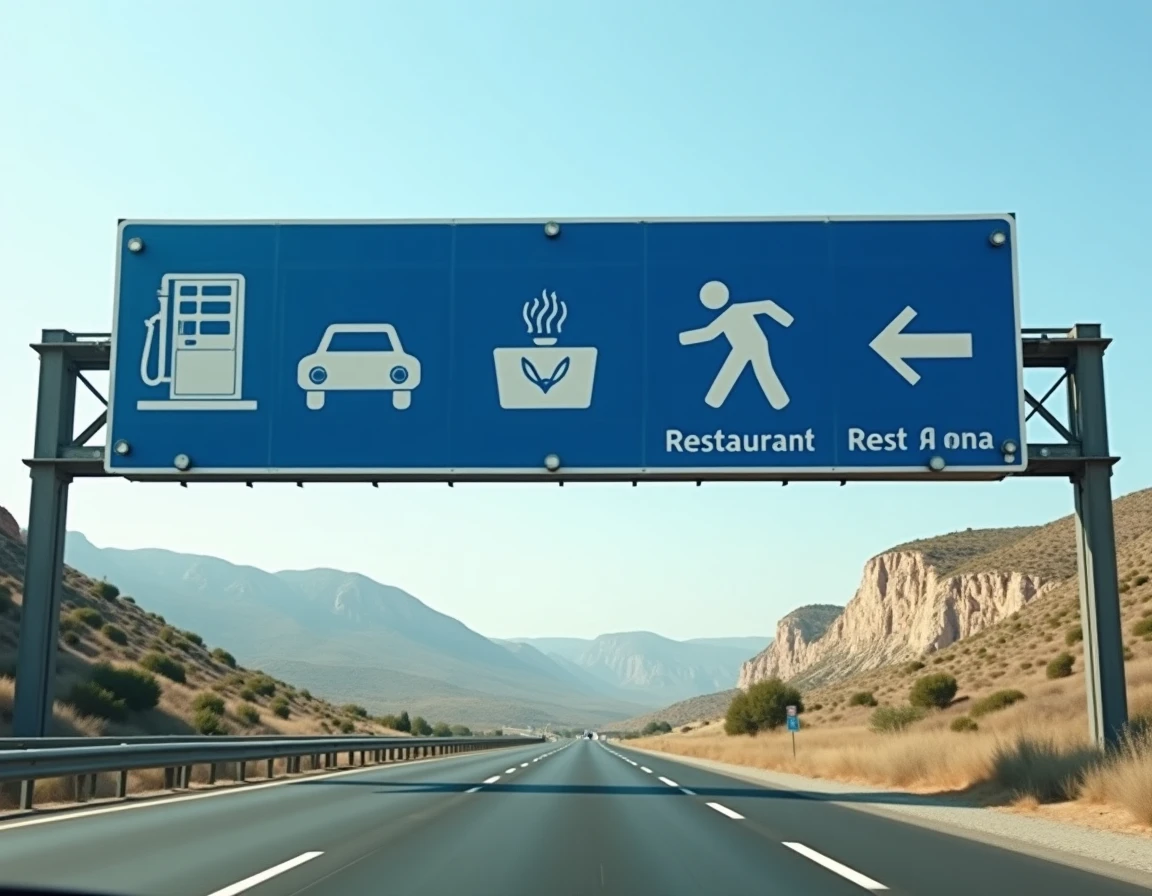
In Spain, a blue sign marked “AP” no longer automatically means that a toll awaits you. Since the end of several highway concessions, entire sections that were once toll roads have come under public management, without the signage always keeping up. This discrepancy between the displayed sign and the actual status of the road regularly traps French drivers, whose GPS sometimes continues to announce a nonexistent toll.
Blue AP sign and autovía A: what the signage really indicates

The Spanish highway network is based on a simple distinction in theory. Roads classified as “A” (autovías) are fast lanes managed by the state and are free of charge. Roads classified as “AP” (autopistas de peaje) are toll highways granted to private operators.
The blue color of the signs is common to both categories. It is the letter that makes the difference, not the background of the sign. A blue “A-7” sign indicates a free autovía. A blue “AP-7” sign indicates, in principle, a toll autopista.
The problem arises when the concession for a toll autopista expires. The road becomes free again, but the sign sometimes retains the AP prefix. This is exactly what has happened on several sections of the AP-7, AP-2, AP-1, and AP-4 since the end of their concessions. A driver who relies solely on the AP code to anticipate a toll risks taking an unnecessary detour through secondary roads.
Understanding the blue signs of free highways in Spain therefore requires checking the current status of each section, rather than relying solely on the displayed prefix.
Free and paid Spanish highways: comparative table by route
The table below summarizes the main routes affected by the end of concessions. It contrasts the old signage (AP) with the actual status observed after expiration.
| Route | Section | Old Status | Current Status | Served Cities |
|---|---|---|---|---|
| AP-7 | Tarragona – Alicante | Toll (AP) | Free | Valencia, Alicante |
| AP-2 | Tarragona – Zaragoza | Toll (AP) | Free | Lleida, Zaragoza |
| AP-1 | Burgos – Armiñón | Toll (AP) | Free | Burgos, Vitoria |
| AP-4 | Seville – Cadiz | Toll (AP) | Free | Jerez, Cadiz |
These four routes cover a significant part of the Spanish highway network. In contrast, other AP sections remain under active concession and still impose a toll. The AP prefix alone is not enough to decide: only checking section by section provides a reliable answer.
Complementary toll-free autovías
Alongside the former freed autopistas, several autovías have never been granted and remain free since their opening. Among them, the A-23 (Levant – Aragon route), the A-66 (Ruta de la Plata, north-south between Gijón and Seville), and the A-68 (Ebro valley) offer concrete alternatives for crossing the country without toll fees.
GPS and routes in Spain: why navigation tools can mislead
The most frequent confusion comes from navigation applications. Several GPS devices and route planners continue to display these sections as toll roads, even after the concession has ended. An outdated GPS announces a toll that no longer exists, leading some drivers to choose longer routes or slower national roads.
This discrepancy is explained by the pace of updates to mapping databases. Map publishers integrate status changes with varying delays, sometimes of several months. For a driver preparing their trip from France, simply reading the route proposed by the GPS does not guarantee reliable information about actual tolls.
Some reflexes can help limit the risk of error:
- Check the last update date of the mapping before departure, whether on a built-in GPS or a mobile app
- Cross-reference the proposed route with a recent source listing expired concessions, rather than relying solely on automatic calculations
- Observe the ground signage as you approach former toll booths: the absence of barriers and booths confirms the section’s free status
Traffic and road conditions after the removal of Spanish tolls
The removal of tolls on these sections has changed traffic conditions. Spanish authorities have documented a notable increase in heavy truck traffic on the former toll autopistas that have become free. The removal of the toll has led to an explosion of truck traffic on certain routes, with direct consequences on the condition of the pavement.
This accelerated degradation of the roadway is accompanied by additional nuisances: traffic jams near interchanges, slowdowns in suburban areas, increased noise for residents. For the French motorist who associates “free highway” with “smooth and comfortable journey,” the reality can be surprising on certain heavily trafficked sections.
Conversely, less frequented sections, such as the AP-4 between Seville and Cadiz, maintain a level of comfort comparable to that of a granted autopista. The driving experience varies greatly from one route to another, which justifies checking the expected traffic level before finalizing a route.
Preparing a trip to Spain: key points to check before departure
The Spanish blue signage does not function as a binary free/paid code. The prefix, the specific section, and the concession end date form a set that must be cross-referenced. A few targeted checks before departure can reduce unpleasant surprises:
- Identify the AP sections on the planned route and individually verify if their concession has expired
- Update the navigation software no later than the day before departure to incorporate the latest mapping changes
- Budget for tolls on sections still under concession, as not all AP sections have become free
The Spanish highway network evolves with the end of concessions. A paid section today may become free in the following months, and the signage will take time to reflect this change. Keeping this logic in mind helps avoid confusing what the sign displays with what the road actually costs.