
A resistance band applies increasing tension as it stretches: the more the band elongates, the greater the load. This property, called progressive resistance, changes the way the abdominal muscles work compared to a bodyweight exercise. The contraction remains intense throughout the entire range of motion, including in phases where gravity alone is no longer sufficient to engage the abdominal belt.
Progressive resistance and abdominal recruitment with a band
In a classic crunch, the difficulty decreases at the end of the movement because the lever arm shortens. With a resistance band, it’s the opposite: the tension peaks when the muscle is at maximum contraction. The rectus abdominis, obliques, and transverse remain under constant load.
This feature makes the band relevant for working on trunk stabilization in various planes (frontal, sagittal, rotational). Among the many abdominal exercises with a band available, those that combine anti-rotation resistance and stabilization produce deep muscle recruitment, particularly of the transverse abdominis.
The choice of band determines the intensity. A band that is too soft does not generate enough tension to provoke an adaptation. A band that is too rigid forces compensation with the back or shoulders, shifting the load away from the abdominal belt.
Anti-rotation abdominal exercises: Pallof press and variations
Anti-rotation is a mechanism often underutilized in abdominal programs. The principle: resist a lateral force that attempts to rotate the torso. The band excels in this area because the tension remains constant regardless of the position.
Standing Pallof press
Attach the band to an anchor point at chest height. Hold the end with both hands, arms bent against the sternum. Push your hands out in front of you, arms extended, then slowly return. The torso must not rotate by a millimeter during the arm extension.
The difficulty increases by moving away from the anchor point or using a stronger band. Three sets of eight to twelve repetitions per side are enough to feel a deep fatigue in the obliques.
Kneeling Pallof press
Same principle, but in a semi-kneeling position (one knee on the ground). This variation reduces the base of support and forces the transverse to compensate more. It serves as a natural progression once the standing Pallof is mastered.
Crunch and stabilization with a band: adapting the load to the movement
The crunch with a resistance band is performed by placing the band behind the upper back, with each end held in the hands. As the torso rises, the band stretches and adds resistance that the rectus abdominis must overcome. The movement remains short: lift the shoulder blades off the ground, no more.
For the front plank, the band is placed around the hips, anchored to the ground by two lateral points. The band pulls the hips down, which forces the transverse and the spinal erectors to stabilize the spine more actively than in a simple plank.
Seated torso rotation
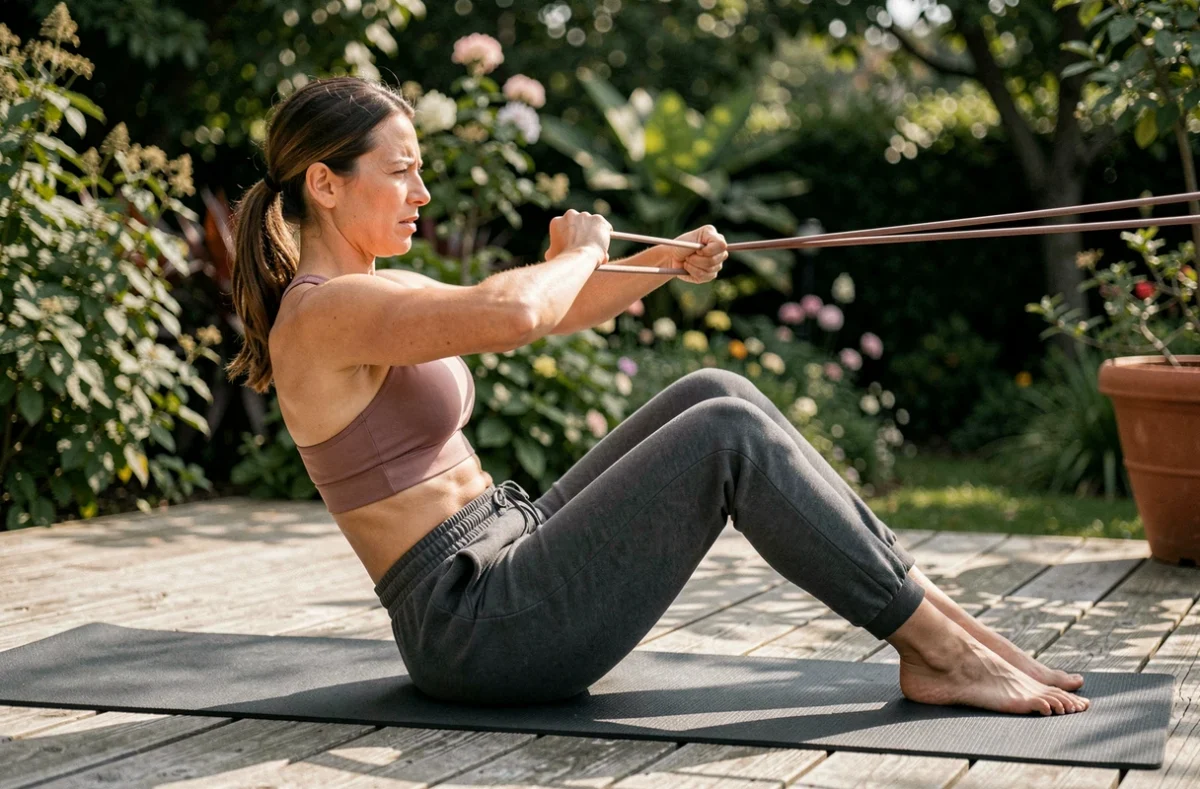
Attach the band to a support at chest height, sit perpendicular to the anchor point, legs bent, feet on the ground. Pull the band by rotating the torso to the opposite side. This movement targets the internal and external obliques with a reduced joint risk compared to free weight rotations, thanks to the gradual increase in tension of the band.
Dynamic movements for abs: mountain climber and dead bug with a band
Dynamic exercises with a band add a coordination component that recruits the neuromuscular system more effectively.
Mountain climber with resistance
Place a mini-band around your feet. In a plank position, bring one knee toward your chest alternately. The band slows the return of the leg, which maintains abdominal tension throughout the set. Slow down the tempo to amplify the stabilization effect.
Dead bug with a band
Lie on your back, arms extended toward the ceiling, with the band connecting one hand to the opposite foot. Simultaneously extend the opposite arm and leg toward the ground without arching your lower back. The band maintains a diagonal tension that forces the transverse to lock the pelvis.
Leg raises with a band
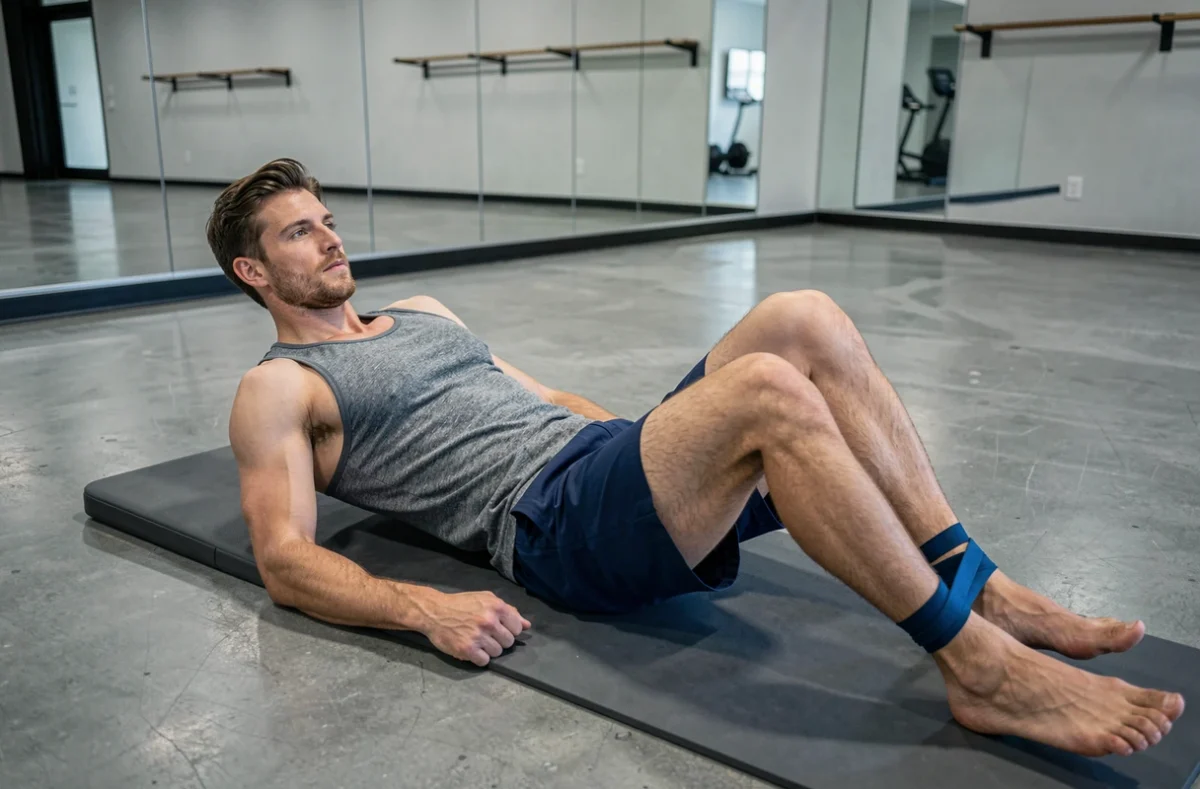
Attach a mini-band around your ankles, lie on your back, hands under your buttocks. Raise your legs straight up to vertical, then slowly lower them without touching the ground. The band adds resistance in abduction that simultaneously engages the obliques and the lower rectus abdominis.
Progressive overload and limits of isolated abdominal work
A common mistake is to multiply exercises without increasing difficulty. The ACSM recommendations remind us that the type of equipment (band, free weights, body weight) matters less than the progressive overload applied session after session. Specifically, this means:
- Switching to a higher resistance band when the twelve-repetition set becomes comfortable
- Slowing down the eccentric phase (returning to the starting position) to increase time under tension without changing bands
- Adding a two to three-second pause at maximum contraction before releasing
- Reducing rest times between sets to maintain high metabolic fatigue
The WHO recommendations published on November 25, 2020, advocate for engaging all major muscle groups at least two days a week. A program focused solely on the abdominals does not replace a comprehensive strengthening that includes legs, back, hips, and shoulders.
Abdominal strengthening improves trunk stability, posture, and can help reduce certain lower back pains. However, it does not lead to localized fat loss in the belly area. Visible muscle definition primarily depends on overall body composition.
Precaution in case of abdominal diastasis
Diastasis of the rectus abdominis requires adapting the load based on symptoms. According to the clinical guidelines from the Kent Community Health NHS Foundation Trust, the load should be reduced if a visible bulge (doming) appears on the midline of the abdomen during exertion. In this case, prioritize low-amplitude stabilization exercises and consult a healthcare professional before progressing in intensity.
The band remains one of the most accessible tools for training the abdominal belt outside the gym. Its value depends less on the number of exercises performed than on the rigor with which tension, tempo, and progression are managed from one session to the next.